Attending the 106th AMS Annual Meeting 2026 in Houston
The delegation, consisting of Dr. Le Duc Trong and M.Sc. Ngo Xuan Truong (VNU University of Engineering and Technology), attended the 106th AMS Annual Meeting in Houston, Texas (USA), held at the George R. Brown Convention Center (GRB), 1001 Avenida De Las Americas, Houston, TX 77010. This is one of the most important annual events in the international meteorology and climate community, bringing together scientists, government agencies, and industry to share advances in research, observation and modeling technologies, and to discuss practical applications for early warning, risk management, and climate adaptation.
Within the conference program, the delegation joined the 25th Conference on Artificial Intelligence for Environmental Science, a specialized track focusing on AI for environmental and Earth system sciences. These sessions reflect the growing role of AI as a core tool in Earth science, thanks to its ability to extract nonlinear relationships from large, multi-source, and noisy datasets. Discussions emphasized the use of AI to produce actionable insights—not only improving predictive performance, but also directly supporting decision-making in areas such as high-resolution climate forecasting, extreme-risk assessment, adaptation/mitigation planning, and identifying vulnerable regions exposed to climate impacts.
On Wednesday, January 28, 2026, the delegation attended Session 9B – Artificial Intelligence for Actionable Insights and Applications in Climate Science (08:30–10:00) in Room 322A, GRB. The session highlighted research applying AI to observational data and climate models, aiming to deliver outputs that can be used by decision-makers and end users—from prediction to climate-risk planning.
In Session 9B, Dr. Le Duc Trong presented Talk 9B.3 (09:00–09:15) on using the deep-learning model TCG-Net (ResNet-18) to reconstruct the climatology of tropical cyclogenesis (TCG) in the Western North Pacific from the MERRA-2 reanalysis dataset. The framework was developed for two tasks: predicting the likelihood of TCG occurrence within the next 48 hours, and reconstructing the spatial distribution over time. The approach incorporates temporal feature enrichment and imbalance-aware training techniques. Results indicate that the model can reproduce key seasonal characteristics and spatial patterns of TCG, suggesting an efficient pathway to complement physics-based approaches in the analysis of climate extremes.
Through activities at AMS 2026, the delegation gained updates on international trends in AI for climate science—especially the shift from “accurate models” toward “decision-useful models,” with strong emphasis on explainability, reproducibility, and practical transfer to climate-risk management.
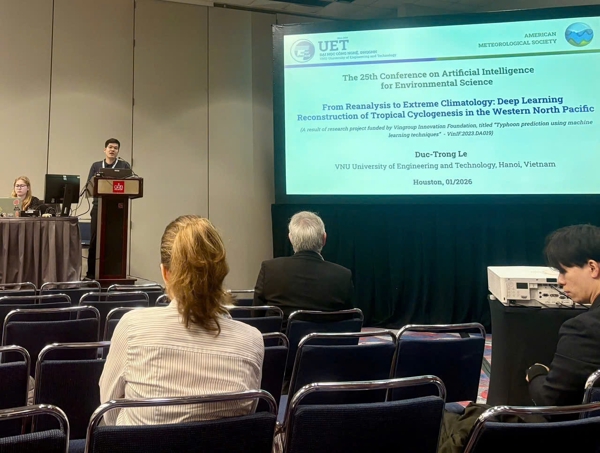
Dr. Le Duc Trong presenting at the conference
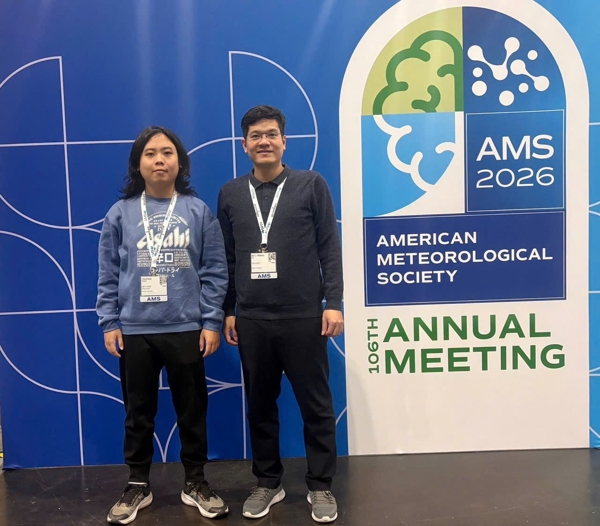
Group photo at the conference
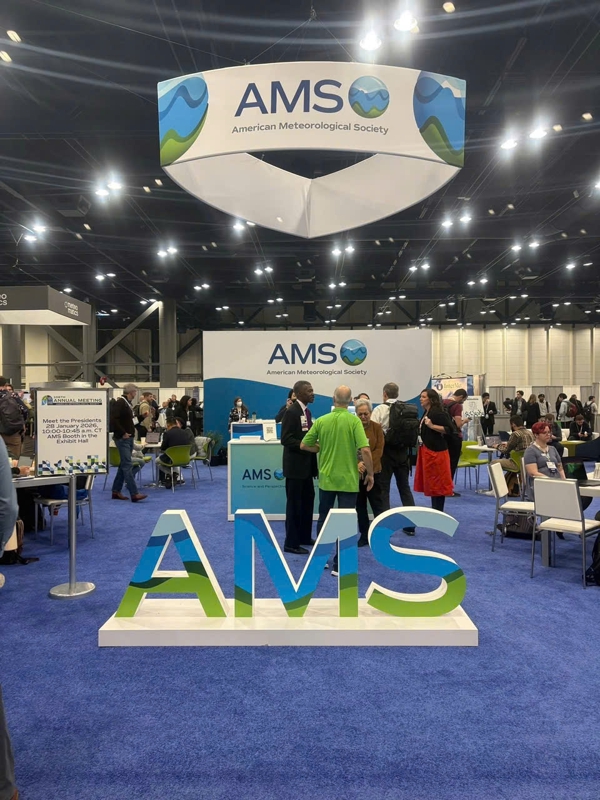
The Exhibit Hall at the conference